

Ngorongoro Crater - A Wildlife Photographers Guide
Updated: Jun 22
Ngorongoro Crater - A Wildlife Photographers Guide
Ngorongoro Crater is one of the most extraordinary wildlife destinations in the world. Often described as the Eden of Africa, this ancient volcanic caldera provides a natural amphitheatre where wildlife thrives within dramatic scenery. For photographers, the Crater is a place of concentrated opportunity, where wide open grasslands, swampy wetlands, acacia woodland, and steep crater walls create a striking backdrop for wildlife portraits and environmental compositions.
Because of its unique geography and exceptionally high density of animals, the Crater offers one of the most reliable photographic experiences in Tanzania. Lions, elephants, buffalo, hyenas, and an array of plains game are seen daily, while rare species like black rhino remain one of the Crater’s most treasured subjects. Whether you are beginning your photographic journey or expanding a professional portfolio, the Ngorongoro Crater delivers a blend of powerful wildlife encounters and dramatic natural beauty.
This photographic guide helps travellers understand how to approach the Crater from a creative and technical perspective. Ngorongoro Crater. A wildlife photographer’s guide covers natural history, photographic subjects, equipment, challenges, lighting, and the rhythm of a day on safari. For those planning a photo safari in Tanzania, the Crater is an essential destination that offers both accessibility and artistic potential.
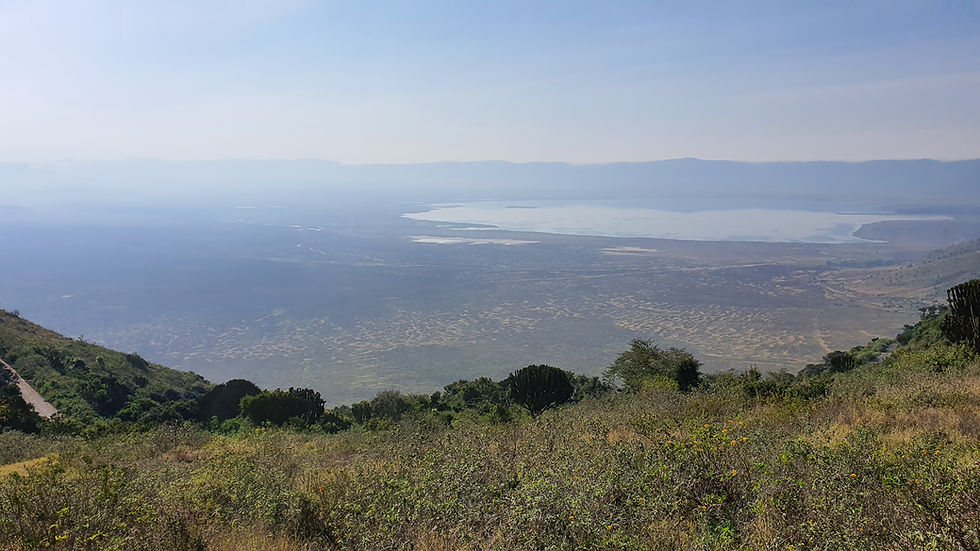
Ngorongoro Crater Natural History
The Ngorongoro Crater was formed approximately two to three million years ago when a massive volcano collapsed inward, creating the largest intact caldera on Earth. This extraordinary geological event produced a natural amphitheatre unlike any other place in Africa. Its steep, circular walls rise more than 600 metres, enclosing a self contained ecosystem where wildlife has flourished for thousands of years. The Crater’s geography creates a sense of isolation and timelessness, with animals living within a bowl of grasslands, swamps, forests, and wetlands that remain visually striking from every angle.
The Crater floor consists of several distinct habitats that together support one of the highest densities of wildlife in East Africa. Open grassland dominates the central plains, providing essential grazing for wildebeest, zebra, buffalo, and gazelles. These expansive areas offer clean backgrounds and consistent opportunities for photographers to capture animal movement and behaviour without visual clutter. Glistening alkaline lakes, especially Lake Magadi, bring dramatic bursts of colour as flamingos gather along the shoreline, feeding in shallow waters and creating sweeping environmental compositions.
Lerai Forest adds an entirely different mood to the Crater. This patch of fever trees provides cool shade for elephants, baboons, and resident leopards that move quietly through the dappled light. Photographers often find unique opportunities here for intimate portraits, especially when elephants emerge from the trees in soft morning mist.
The Gorigor Swamp and surrounding wetland areas form one of the most productive feeding grounds in the region. Hippos wallow in its pools, while the swamps attract the Crater’s legendary old bull elephants, known for their immense tusks and calm nature. These bulls often feed in thick vegetation at the swamp’s edge, where rising moisture and moody skies create atmospheric scenes ideal for portrait and environmental photography.
Unlike many parks in Tanzania, Ngorongoro’s wildlife remains inside the Crater year round. The permanent water sources, stable grazing, and natural protection provided by the crater walls create an environment where animals rarely need to leave. This consistency results in a predictable photographic landscape, giving visitors opportunities to work with an impressive variety of species in every season. Whether visiting during the green months, when clouds hang low over the rim, or during the dry season, when visibility is high and light is crisp, the photographic potential is always strong.
From mist rolling down the crater walls at sunrise to flamingos lifting in unison from the lakes, and lions resting on open plains with crater walls sweeping behind them, Ngorongoro’s natural history shapes every photographic moment. It is this unique blend of geology, wildlife density, and dramatic scenery that underpins its reputation as one of the most scenic and rewarding locations for wildlife photography anywhere in Africa.
Getting to the Ngorongoro Crater
The Ngorongoro Crater is easily accessible from Arusha, typically requiring a three to four hour drive along well maintained roads. Most travellers visit the Crater as part of a broader northern circuit itinerary that includes Tarangire, Serengeti, and Lake Manyara.
Entry into the Crater is controlled through specific descent routes, with game drives limited to daylight hours. Photographers often begin the journey early in the morning, allowing for a descent through rolling cloud and mist that softens the landscape and provides atmospheric shooting conditions.
The Crater rim offers some of the most beautiful lodge views in Tanzania, with wide panoramas overlooking the caldera. Staying on the rim ensures easy access at sunrise, giving photographers the advantage of early light and reduced vehicle numbers.
Fighting Flamingos - Ngorongoro Crater Photo Safaris Fighting Flamingos - Ngorongoro Crater Photo Safaris
Ngorongoro’s Photographic Subjects
Ngorongoro Crater offers one of the highest densities of big game in Africa. This concentration allows photographers to work with a variety of subjects in a single session, each supported by dramatic scenery and clean backgrounds.
Lions
Ngorongoro has one of the densest lion populations in Tanzania. Prides are often found resting on open grasslands, walking across plains at sunrise, or interacting near swamp edges. The Crater’s soft light and clean horizon lines help produce strong portraits and behavioural sequences.
Elephants
The bull elephants of Ngorongoro are iconic. Known for their large tusks and peaceful nature, they frequent Lerai Forest and the swamp areas. These bulls often feed in soft morning mist, creating atmospheric opportunities that feel almost dreamlike.
Rhinos
The Crater is one of the few places in Tanzania where black rhinos can be reliably seen. Although often at a distance, the Crater’s open plains still allow for meaningful photographic opportunities when rhinos move, graze, or stand against sweeping backdrops.
Hyenas and Jackals
Spotted hyenas thrive in the Crater and are frequently observed hunting, scavenging, or interacting socially. Their presence provides dramatic storytelling opportunities. Jackals are also common and often photograph well in side light.
Birdlife
The alkaline lake and surrounding wetlands attract flamingos, pelicans, herons, and a wide variety of raptors. These birds add colour and movement to wide angle and environmental shots.
General Game
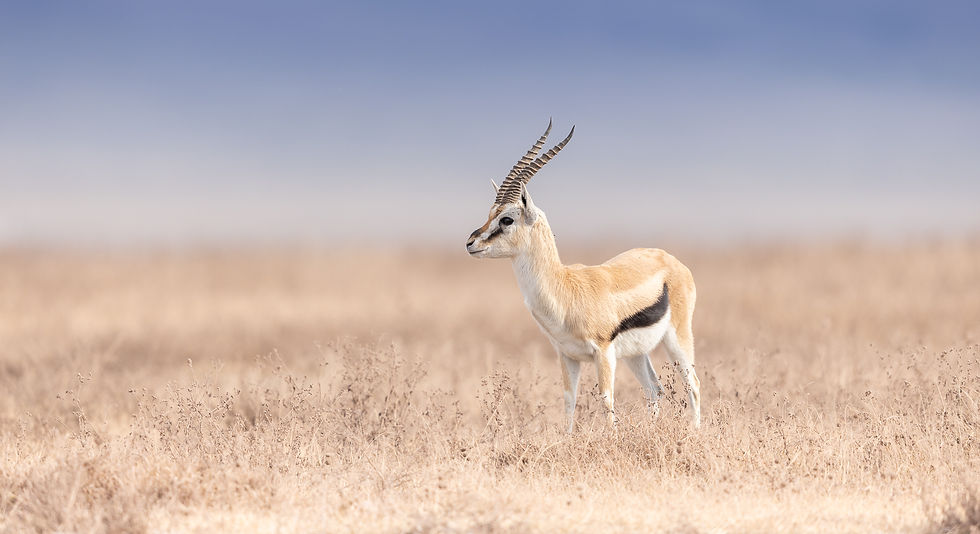
Wildebeest, zebra, gazelles, buffalo, and warthogs dominate the landscape. Their presence helps create layered scenes and supports storytelling compositions that highlight life within the Crater.

Equipment to Bring
For a dedicated wildlife photography safari in the Ngorongoro Crater, we recommend the following equipment. Please note that the following kit recommended by the untamed team is not mandatory and is more of a guide line. When attending a photographic safari with Untamed Photo Safaris, you do not need to bring all of the following as talked about below.
Telephoto Lens (300mm to 600mm range)
Long lenses are essential for isolating subjects on the Crater floor, where wildlife often appears against wide open grasslands or distant crater walls. Lions, hyenas, jackals, and especially black rhinos frequently require significant reach to achieve clean compositions without environmental distractions. A 100 400mm or 100 500mm zoom provides excellent flexibility, allowing photographers to adapt quickly as animals move closer or shift position. Prime lenses such as 300mm, 400mm, and 600mm offer superior sharpness, beautiful compression, and the ability to separate subjects from busy backgrounds. In the Crater, primes are particularly valuable during soft morning light, when visibility is high and fine details in fur and feathers stand out beautifully.
Mid-range Zoom (70-200mm or 70-300mm)
This is one of the most versatile focal ranges in the Crater and often produces the most balanced storytelling images. Elephants and buffalo frequently approach roads and marsh edges at distances that suit this lens perfectly. It allows photographers to capture entire bodies without cutting off limbs, while also keeping enough environmental context to show behaviour or interactions. This range is ideal for photographing lions walking across plains at sunrise, hyenas in social groups, and general game that moves in layered formations. The ability to zoom through mid-range focal lengths also helps frame subjects against crater walls for dramatic environmental portraits.
Wide Angle Lens (24-70mm or similar)
The Crater’s scenery is one of its most powerful assets and is best captured with a wide angle lens. This focal range is perfect for environmental portraits, especially when elephants or wildebeest move through soft light with sweeping crater walls behind them. It is also ideal for capturing storm fronts, mist rolling off the rim, and wide scenes that show the scale and mood of the caldera. A wide angle lens encourages creative compositions by allowing photographers to work with lines, clouds, and foreground elements, such as wildflowers or textured grasses, to enhance visual depth.
Two Camera Bodies
Having two bodies enables photographers to switch between focal lengths instantly, which is essential in a location where action can unfold quickly and unpredictably. For example, a lion might suddenly begin to hunt while flamingos take flight on the lake behind you. Carrying two bodies eliminates the need to change lenses in dusty or windy conditions, protecting your sensor while ensuring you never miss a key moment. It also means each body can be optimised with different settings, such as one prepared for fast shutter speeds and another for landscapes or environmental frames.
Beanbag or Stabilisation
Most photography in the Crater is done from within the vehicle due to strict off-road regulations. A beanbag provides a stable and adaptable platform for long lenses, particularly when photographing from window frames or the roof hatch. This stability is crucial for sharp results, especially in lower light when shutter speeds drop or when tracking moving subjects like hyenas or jackals. A stable shooting base also helps maintain composition during early morning mist, when contrast is lower and precision is essential.
Polariser (optional)
A polariser can be extremely useful around the Crater’s lake systems and wetland areas where glare from water and bright sky can reduce detail and colour. It helps deepen blue tones, enhance cloud structure, and bring out subtle colour variation in flamingos and wading birds. During the green season, when foliage is vibrant and the atmosphere is moisture rich, a polariser can significantly improve saturation and clarity in landscape images. While not essential during the dry season, it remains a valuable tool for selective scenes where reflections or bright skies dominate the frame.
Zoom Lenses vs Prime Lenses
Choosing between zoom lenses and prime lenses is one of the most important decisions a wildlife photographer makes in the Ngorongoro Crater. Both lens types perform exceptionally well in this environment, but each offers distinct advantages that influence composition, flexibility, and the overall aesthetic of your images.
Zoom Lenses (100–400mm / 100–500mm)
Zoom lenses provide versatility, which is especially valuable in the Crater where wildlife often moves across open space or shifts behaviour quickly. A 100 400mm f4.5 5.6 or 100 500mm f4.5 7.1 allows photographers to adjust focal length instantly, making it easier to track lions walking across plains, hyenas interacting, birds taking flight, or rhinos changing distance.
The higher f stop values of zoom lenses mean they let in less light compared to their prime equivalents. This can affect low light performance during early morning mist or late afternoon storm light. However, modern zoom lenses remain remarkably sharp and pair well with the bright conditions typical of the Crater. For photographers who prioritise adaptability and speed, zooms are an essential part of the kit.
Prime Lenses (300mm f2.8 / 400mm f2.8 / 600mm f4)
Prime lenses excel in image quality. Their lower f stops such as f2.8 or f4 allow more light into the lens, producing faster shutter speeds and stronger background separation. In Ngorongoro, this is especially beneficial when photographing subjects against textured scenery or in challenging light.
For example, a lion resting in long grass, a hyena moving across a misty plain, or a rhino silhouetted against crater walls can all benefit from the shallow depth of field and smooth bokeh provided by wide apertures. The ability to shoot at lower ISO values also preserves fine detail, making primes the strongest choice for artistic portraits and low light conditions.
The trade off is reduced flexibility. With a fixed focal length, composition depends heavily on vehicle positioning and the photographer’s ability to anticipate behaviour. Still, for photographers whose priority is maximum sharpness and the ability to isolate subjects beautifully, prime lenses are unmatched.
Which Should You Bring?
Both lenses have clear strengths in the Ngorongoro Crater.• Zoom lenses deliver flexibility and speed for fast changing scenes.• Prime lenses deliver superior image quality, low light performance, and strong subject separation.
Many photographers choose to carry one of each, mounting a zoom on one camera body and a prime on the other. This setup covers every scenario the Crater presents, from distant rhinos to close elephants, from sweeping landscapes to tight behavioural portraits.
Spotted Hyena - Ngorongoro Crater Photo Safaris African Elephant - Ngorongoro Crater Photo Safaris Baby Zebra - Ngorongoro Crater Photo Safaris
Tips for Overcoming Ngorongoro Crater’s Photographic Challenges
Understanding the Crater’s challenges is only the first step. Photographers who prepare with the right techniques and settings can turn difficult conditions into creative advantages. The following tips provide practical ways to navigate each challenge effectively.
Managing Midday Haze
Heat haze softens detail and can make distant subjects appear blurred.
How to overcome it:
Avoid long distance subjects during peak heat. Focus on closer wildlife or move to shaded habitats like Lerai Forest.
Use haze creatively. Backlit haze can produce soft, dreamy images with warm atmosphere
Increase contrast in camera by switching to flat light or cloudy white balance and adjusting exposure compensation.
Recommended settings:
Aperture: f4 to f8 depending on subject distance
Shutter speed: 1/1250 or faster to maintain crispness
ISO: 400 to 800 depending on light
White balance: Cloudy or daylight
Exposure: Slight underexposure (minus 0.3) to hold detail
Photographing Rhinos at Long Distance
Rhinos often remain far from the road, requiring specific techniques to maximise quality.
How to overcome it:
Use long lenses (500mm to 600mm) to isolate the subject where possible.
When distance prevents tight portraits, embrace wide environmental compositions to show scale.
Wait for behaviour such as walking, head raises, or grouping. Movement creates stronger storytelling frames even at long distances.
Avoid shooting through heat haze. Early morning and late afternoon give the cleanest air.
Recommended settings:•
Aperture: f4 to f7.1 depending on desired depth of field
Shutter speed: 1/1600 or faster for movement
ISO: 200 to 800 depending on light
Drive mode: High speed burst for behaviour changes
Adapting to Changing Light
Ngorongoro’s light can move from bright sun to thick mist in minutes.
How to overcome it:
Use Auto ISO to adapt quickly but set a maximum ISO you are comfortable with.
In mist, shoot high key with slight overexposure to enhance softness.
In strong sun, switch to side light or back light to create depth.
In storm light, use the dramatic sky as a compositional element and allow shadows to deepen for mood.
Recommended settings:
For misty or soft light:
Aperture: f2.8 to f5.6
Shutter speed: 1/800 to 1/1250
ISO: 400 to 1600 depending on visibility
Exposure: Plus 0.3 to plus 0.7 for high key
For harsh midday light:
Aperture: f5.6 to f8
Shutter speed: 1/2000 or faster
ISO: 100 to 400
Exposure: Minus 0.3 to maintain highlights
For dramatic storm light:
Aperture: f4 to f7.1
Shutter speed: 1/1600
ISO: 200 to 640
Exposure: Keep neutral to preserve sky detail

Lighting in Ngorongoro Crater
The Crater offers some of the most varied and beautiful lighting conditions in East Africa. Its high rim, steep walls, open plains, and reflective wetlands create a constantly shifting atmosphere that photographers can use to their advantage. Understanding how to work with each type of light helps produce images with depth, mood, and clarity.
Morning Mist
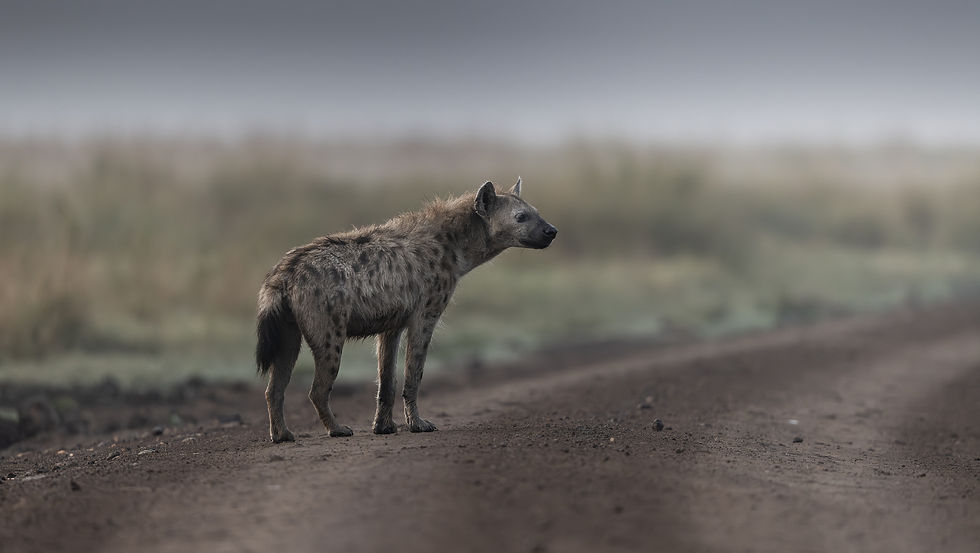
Descending into the Crater at sunrise often reveals a layer of soft mist that diffuses the light perfectly. This creates gentle shadows, cool tones, and a cinematic mood that works beautifully for elephant bulls feeding near the forest, hyenas moving across plains, and wide landscapes that show the scale of the caldera. Mist also reduces contrast, allowing for more delicate and painterly images.
Photographic tips:
Look for silhouettes of elephants emerging through haze.
Use the mist to simplify backgrounds and isolate subjects like the hyena shown below.
Position yourself with the mist behind your subject to create glowing edges.
Recommended settings:
Aperture: f2.8 to f5.6 for soft separation
Shutter speed: 1/800 to 1/1250
ISO: 400 to 1600 depending on density of mist
Exposure compensation: Plus 0.3 to plus 0.7 to avoid underexposure in foggy conditions
White balance: Cloudy or shade for warm tones, or auto for neutrality
Soft Overcast Light
Cloud cover is common in the Crater and works beautifully for portraits. Overcast skies act as a natural softbox, reducing harsh shadows and preserving detail in fur, eyes, and textures. Lions resting on plains, close elephant portraits, and hyena interactions are particularly strong in this light because the contrast remains manageable.
Photographic tips:
Focus on behaviour and fine detail since the light is gentle and evenly distributed.
Use mid range focal lengths for portraits without worrying about strong highlights.
Overcast skies allow shooting throughout the day without harsh-light restrictions.
Recommended settings:
Aperture: f4 to f7.1 for balanced depth
Shutter speed: 1/1250 or faster for movement
ISO: 400 to 800
Exposure compensation: Neutral
White balance: Cloudy for warmth or auto for natural tones

Golden Light
Late afternoon sun creates long shadows and warm tones across the grasslands. This is ideal for backlit images, rim lighting, dust interactions, and silhouettes of wildebeest, buffalo, and birds in flight. Golden hour in Ngorongoro often appears more dramatic because the crater walls reflect warm tones across the plains.
Photographic tips:
Shoot backlit subjects to capture glowing fur and dust.
Use side light to enhance muscle definition in lions and buffalo.
Look for long shadows to add depth to wide environmental images.
Recommended settings:
Aperture: f2.8 to f5.6 for glowing backgrounds
Shutter speed: 1/1600 or faster to capture movement in strong light
ISO: 100 to 400
Exposure compensation: Minus 0.3 for backlit scenes, neutral for side light
White balance: Daylight or cloudy to enhance warmth

Storm Light
Storm light is one of the Crater’s most dramatic and rewarding conditions. Dark clouds hanging over bright grasslands create high contrast scenes that feel cinematic and atmospheric. This is perfect for environmental storytelling, especially when photographing large mammals such as elephants, rhinos, and buffalo against the approaching storm.
Photographic tips:
Use the dark sky as a backdrop to make subjects stand out.
Embrace contrast. Shadows add mood and depth.
Look for breaks in the cloud where shafts of light illuminate animals on the plains.
Recommended settings:
Aperture: f4 to f8 depending on the composition
Shutter speed: 1/1600 or faster for moving subjects
ISO: 200 to 640
Exposure compensation: Neutral or minus 0.3 to preserve dramatic sky detail
White balance: Auto or daylight to keep natural tones

The recommended camera settings in this guide are designed to work across a practical range of lenses commonly used for wildlife photography in the Ngorongoro Crater. These include:
Prime Telephoto Lenses
300mm f2.8
400mm f2.8
500mm f4
600mm f4
Zoom Telephoto Lenses
70–200mm f2.8
100–400mm f4.5–5.6
100–500mm f4.5–7.1
A Day on a Photo Safari in the Crater
A typical photographic day begins before sunrise. Photographers leave the lodge while the Crater rim is still cool and often shrouded in low cloud. As the vehicle descends into the caldera, the landscape opens in a breath taking reveal, offering panoramic views and shifting layers of light.
Morning drives focus on predators, elephant bulls in mist, and general game interactions. As light strengthens, photographers explore the lake edges, scanning for flamingos and wading birds.
Lunch is often taken at designated picnic areas overlooking hippo pools or open plains. Afternoon sessions concentrate on golden light, hunting activity, and sweeping environmental scenes with long shadows across the grass.
As the sun lowers behind the crater wall, the return ascent offers a final chance to capture the landscape lit with warm evening tones.

Our Thoughts
If you have enjoyed reading the Ngorongoro Crater - A Wildlife Photographers Guide, We hope you have understood that Ngorongoro Crater is a place where wildlife, scenery, and atmosphere combine to create an unparalleled photographic experience. The density of animals, the diversity of habitats, and the shifting light make every drive feel purposeful. Whether capturing the calm strength of an elephant bull, the movement of hyenas across the plains, or the scale of the caldera itself, the Crater offers endless creative potential for wildlife photographers.
Read all about what makes Tarangire National Park a photographers paradise.
Join Us on Safari
Untamed Photo Safaris leads professional photographic journeys across Tanzania, including dedicated days in the Ngorongoro Crater. With personalised guidance and a strong focus on ethical wildlife viewing, our safaris are designed to help photographers of all levels create powerful images and develop their skills in the field.
If you would like to join us in Tanzania or learn more about our upcoming photographic safaris, we would be honoured to guide you through one of the world’s greatest natural wonders.
Written By Wildlife Photographer Mark A Fernley


