

Samburu National Reserve - A Wildlife Photographers Guide
Updated: Jun 22
Introduction - A Wildlife Photographers Guide to Samburu National Reserve
Samburu does not offer endless green plains, dramatic river crossings, or the density of predators that define migration season. Instead, Samburu offers something quieter, more specialised, and for the serious wildlife photographer, something deeply rewarding.
Set in northern Kenya along the banks of the Ewaso Nyiro River, Samburu National Reserve presents a raw, semi-arid landscape of doum palms, acacia scrub, rocky outcrops and open sandy riverbeds. The colours are different. The light feels harsher. The air carries dust instead of moisture. The wildlife behaves differently here. For photographers, this creates opportunity.
Samburu is one of the few places in East Africa where you can reliably photograph species that are absent from the southern ecosystems. It is a destination that rewards patience, understanding of light, and thoughtful composition. It is not about chasing numbers. It is about crafting images that feel distinct.
When we bring photographers to Samburu, the intention is clear. This is where we refine vision. This is where we slow down. This is where we photograph with purpose.

Photographic Safari, Samburu National Reserve 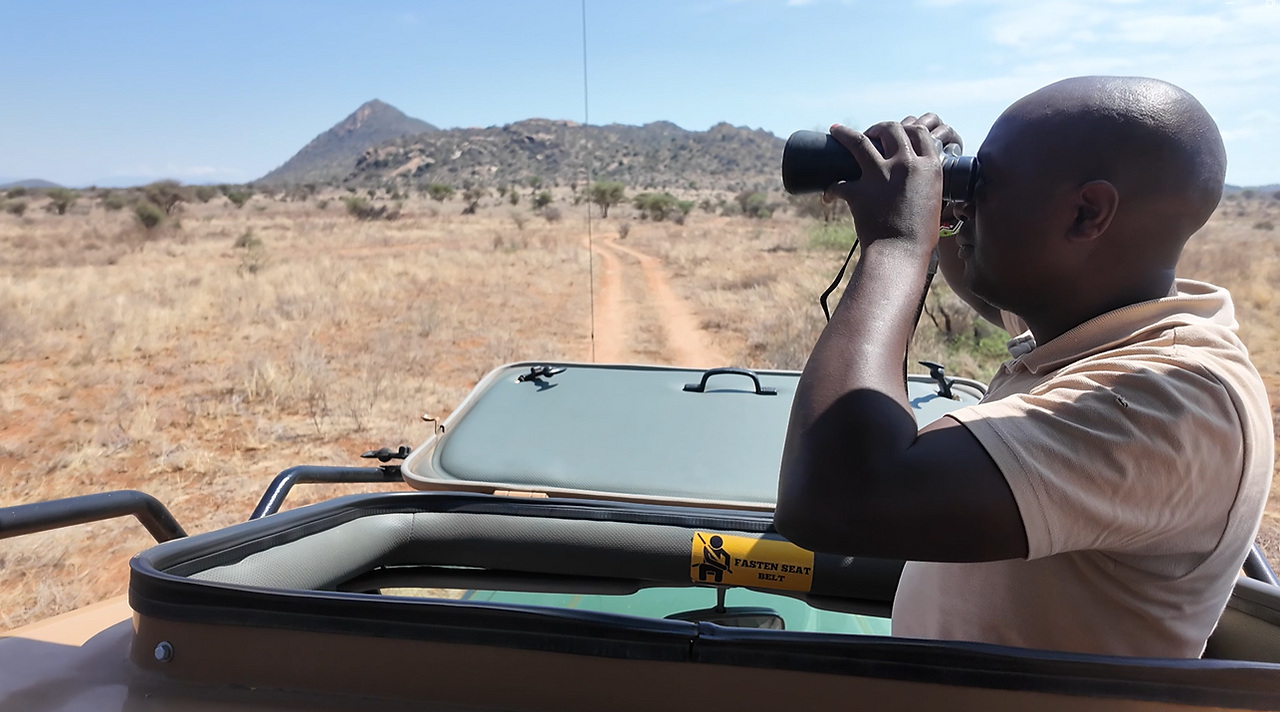
A photo safari driver on the look out, Samburu National Reserve
The Natural History of Samburu
Samburu sits within Kenya’s northern rangelands, an ecosystem shaped by heat, seasonal rainfall and the life-giving presence of the Ewaso Nyiro River. As explored in this Wildlife Photographer’s Guide to Samburu National Reserve, the river is everything here. During the dry months it becomes the focal point for survival. Elephant herds dig into sandy banks for water. Grevy’s zebra gather in small, tight-knit groups. Lions rest beneath doum palms as the temperature climbs.
Unlike the Mara’s open grassland system, Samburu is characterised by thorn scrub, Commiphora woodland and rocky ridges. Vegetation is sparser. Visibility can be both challenging and rewarding. You are often shooting through layers of branches, framing subjects within textured foregrounds.
The region is also culturally significant, home to the Samburu people, whose pastoral traditions have coexisted with wildlife for generations. This coexistence has shaped a landscape where animals remain relatively relaxed around vehicles, yet retain their wild, alert character.
Rainfall patterns are less predictable than southern Kenya. The long dry season intensifies dust, strengthens contrast, and produces dramatic scenes along the riverbanks. After rain, the reserve transforms briefly with fresh greenery, softer light reflection, and renewed wildlife movement.
From a natural history perspective, Samburu is defined by adaptation. Species here have evolved to withstand heat, limited water, and sparse forage. That resilience translates beautifully into photography. Every image carries a sense of endurance.

Getting to Samburu
From Nairobi by Road
The drive from Nairobi to Samburu takes approximately five to six hours, depending on traffic and road conditions. The route passes through central highlands before descending into drier northern terrain. The landscape change is gradual and photographic in itself.
For photographers travelling with gear, road transfer allows flexibility. You are not restricted by airline weight limits, and you can transport long lenses and backup equipment without concern. The downside is time and road fatigue.
From Nairobi by Air
Several daily scheduled flights operate from Wilson Airport in Nairobi to Samburu’s airstrips. The flight time is roughly one hour. From the airstrip, it is a short transfer into the reserve or lodge.
Flying is efficient and significantly reduces travel fatigue, especially when connecting from international arrivals. For photographers managing heavy equipment, it is important to confirm luggage allowances in advance.
From the Masai Mara to Samburu
For those combining ecosystems, such as on our Masai Mara and Samburu Photo Safari, we fly between the Mara and Samburu via Nairobi. Direct charter flights are possible but often less practical for small groups.
The aerial transition between the lush Mara and the arid north is striking. From above, you see the shift in vegetation density, river systems and terrain structure. It reinforces just how diverse Kenya truly is.

Wildlife Photographer Jaren A Fernley 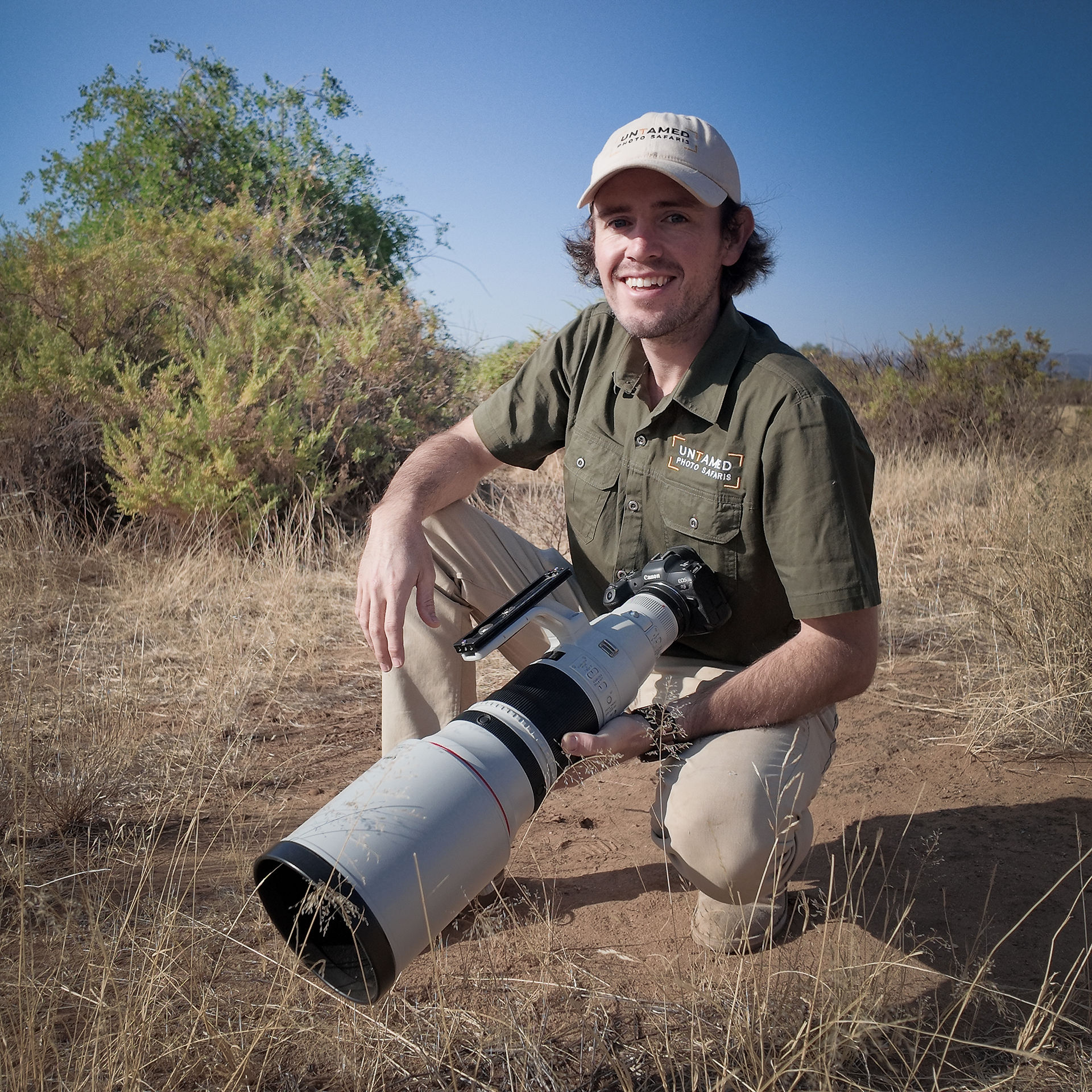
Wildlife Photographer Mark A Fernley
Wildlife Photography in Samburu
Samburu demands intention. Unlike high-density predator ecosystems, wildlife encounters here can require more patience. That is precisely why it is so valuable for photographers. You learn to anticipate behaviour rather than react to chaos.
The Ewaso Nyiro River forms a natural stage. Animals approach cautiously. They drink. They interact. They cross. It is an ideal environment for behavioural storytelling.
Dust becomes part of the composition. Backlit elephants throwing sand over themselves. Lions moving across pale riverbanks. Grevy’s zebra standing in clean morning light against dark scrub.
Because vegetation is more textured and layered than the Mara, composition becomes more deliberate. You cannot simply isolate subjects against open plains. You must work angles, reposition vehicles carefully, and use depth creatively.
This is a place to practise fieldcraft.
Photography Subjects: The Special Five and Beyond
The Samburu Special Five
Samburu is famous for five species often referred to as the “Special Five”:
Grevy’s Zebra
Reticulated Giraffe
Somali Ostrich
Beisa Oryx
Gerenuk
Each offers unique photographic characteristics.
Grevy’s Zebra
Larger than the common plains zebra, with narrower stripes and a distinct white belly, Grevy’s zebra offer some of the most graphic compositions available in northern Kenya. Their stripe pattern is tighter and more intricate, which creates powerful visual rhythm when framed correctly.
Unlike plains zebra, Grevy’s are often seen in smaller, looser groups. This provides opportunities for clean portraits without overlapping bodies or distracting legs cutting through the frame.
From a photographic standpoint, they are ideal for both tight headshots and mid-range environmental portraits. A 400mm to 600mm lens allows you to isolate facial detail and emphasise the symmetry of the stripes. Position slightly off-centre and use negative space to avoid static compositions.
Techniques to consider:
Focus on eye-level portraits to enhance intimacy
Use side light to emphasise stripe texture and contour
Slightly underexpose in harsh light to preserve white detail
Look for interaction between mares and foals for storytelling
Backlighting can also be effective early in the morning, especially if dust is present. The stripe pattern becomes abstract when partially silhouetted.

Reticulated Giraffe
The reticulated giraffe’s geometric coat pattern is exceptionally photogenic. The clean white lines separating rich brown patches create natural contrast that responds beautifully to directional light.
Because of their height, composition becomes critical. Shooting from a slightly elevated vehicle position can flatten perspective, so lowering your angle where possible creates a stronger, more intimate result.
Soft early morning light enhances the warmth in their coat without overexposing highlights. A 70-200mm works well for environmental compositions, particularly when incorporating acacia branches as natural framing elements.
Photographic techniques:
Position for side lighting to emphasise texture
Use acacia trees to frame the neck and head
Shoot vertically when isolating full-body standing poses
Wait for clean neck curves without awkward angles
When giraffe feed or walk in single file, use compression at 400mm or longer to create layered compositions with repeating patterns.

Somali Ostrich
Somali ostrich are distinguished by their blue-grey necks and legs, which separate them visually from their southern relatives. Males in breeding condition can be particularly striking against pale scrubland.
Because they move frequently across open terrain, shutter speed is important. Aim for 1/1600 sec or higher if capturing running behaviour.
Environmental compositions are particularly effective here. A mid-range zoom allows you to include surrounding scrub, sky and ground texture, giving scale and context.
Techniques to consider:
Use low angles to separate them from cluttered backgrounds
Capture stride moments when both legs are extended
Slightly overexpose in pale sand to avoid dull tones
Frame with space in front to emphasise movement direction
Backlighting works well in early morning, accentuating feather structure and body outline.

Beisa Oryx
With long, straight horns and bold facial markings, Beisa oryx photograph best in strong side profile. Their symmetry and horn length create elegant, minimalist compositions.
Because horns are long and sharp, ensure sufficient depth of field. At close range, f5.6 or f6.3 may be safer to keep both eyes and horn bases sharp.
Low sun angles transform oryx photography. Dust rising behind them creates natural separation, and side light enhances facial contrast.
Photographic techniques:
Wait for clean side profiles with parallel horn alignment
Use negative space for minimalist compositions
Shoot low to elongate horn perspective
Watch backgrounds carefully to avoid horn overlap with trees
A 400mm to 500mm lens is ideal for isolating individuals from herd clutter.

Gerenuk
Perhaps the most unusual of the Special Five, the gerenuk often stands upright on its hind legs to browse from shrubs. This behaviour creates one of Samburu’s most iconic photographic moments.
Capturing that posture requires anticipation. Watch for the subtle shift before they rise. Pre-focus and maintain continuous autofocus.
A longer lens, 500mm or more, helps isolate the vertical form against open scrub. Position yourself for side light to reveal the slender neck and body shape.
Techniques:
Shoot vertical orientation to emphasise height
Leave space above the head to avoid cramped framing
Use f4 to separate subject from thorny backgrounds
Capture the full extension moment rather than halfway lift
Patience is key. The gesture may last only seconds.

Leopards, Lions, Elephants & More
Samburu may be known for its Special Five, but its predators and larger mammals give the reserve real photographic depth. Lions patrol the sandy banks of the Ewaso Nyiro and rest beneath doum palms, their pale coats blending beautifully with the arid terrain. Leopards thrive along the riverine woodland, often draped across thick branches or moving silently through filtered morning light.
Elephants dominate the landscape during the dry months, large bulls and family herds gathering at the river, where dust, water and low sun create dramatic, textured scenes. Beyond these headline species, Samburu supports cheetah, striped hyena, crocodile, buffalo and a wide range of birdlife, all adapted to this harsher northern ecosystem. For wildlife photographers, the combination of predators, megafauna and uniquely adapted species within a raw, semi-arid setting creates images that feel distinctly different from the southern safari circuits.
Recommended Lenses for Samburu
For serious wildlife photography, I recommend the following focal length coverage.
Long Range: 400mm to 600mm
A 500mm or 600mm prime is ideal for isolating subjects within busy scrub. It allows you to compress background texture and simplify compositions. With leopard and smaller antelope species, reach is critical. A 100-500mm or 200-600mm zoom provides flexibility when subjects shift distance rapidly.
Mid Range: 70-200mm
Essential for environmental portraits. Elephants at the river, giraffe in layered acacia woodland, oryx against open terrain. This range gives storytelling context.
Wider Perspective: 24-70mm
Often overlooked in Samburu. Wide angles can be powerful when animals approach riverbanks or when dust storms roll across open ground. Used thoughtfully, they create immersive frames.

Marshal Eagle - Samburu National Reserve 
Vulturine Guinea fowl - Samburu National Reserve
Lighting Situations and Overcoming Challenges
Early Morning Light
This is challenging light. It is strong, overhead and unforgiving, creating deep shadows beneath animals and bright highlights across pale sand and light-coloured coats. Contrast increases rapidly, and dynamic range becomes difficult to manage.
Position subjects carefully to minimise extreme contrast. Whenever possible, work with animals that are partially in open shade or standing at the edge of shadow lines. This softens transitions and retains detail. Expose conservatively to protect highlights, especially on elephants and Grevy’s zebra. Slight underexposure can preserve texture that would otherwise clip in harsh sun. Consider simplifying compositions and focusing on graphic elements, strong shapes or tight portraits where background distraction is reduced.
Low Light Conditions
Dawn in riverine woodland can be dim, particularly when thick vegetation blocks early sunlight. Light levels fluctuate quickly, and autofocus performance can slow in deep shade.
Increase ISO confidently. Modern sensors handle noise exceptionally well, and a sharp image with moderate grain is always preferable to a blurred one. Prioritise shutter speed to preserve sharpness, especially with active subjects such as leopard or elephant calves. Open your aperture to f2.8 or f4 when needed, but be mindful of depth of field with larger animals. Continuous autofocus with subject tracking helps maintain precision as animals move through patches of light and shadow.
Heatwaves and Distortion
As temperatures rise, heat haze can distort long lens images, particularly across open sandy riverbeds. Even minor atmospheric shimmer can soften fine detail at 500mm and beyond.
Minimise shooting distance whenever possible. The less heated air between you and the subject, the sharper your results will be. Lower your angle to reduce the vertical column of warm air in front of the lens. Shoot earlier and later in the day when ground temperatures are lower. If distortion becomes unavoidable, shift to closer subjects, wider focal lengths, or focus on behaviour rather than critical detail.
Samburu's Photo Hide - Ground-Level Day and Night Photography
One of the most exciting additions to Samburu for wildlife photographers is the dedicated photo hide at Larsen’s Camp. Positioned discreetly near the lodge and built at ground level, the hide offers a completely different photographic experience from traditional vehicle-based game drives. This is eye-level photography. Intimate. Controlled. Purposeful.
The hide overlooks a carefully positioned water source that attracts a variety of wildlife both during the day and after dark. It allows us to work with precision, especially when teaching composition, lens choice and light control.


Male Elephant Drinks at a photographic safari hide waterhole - Samburu National Reserve 
Jaren A Fernley photographs wildlife from a photo safari hide in Samburu National Reserve. 
Male Elephant Drinks at a photographic safari hide waterhole - Samburu National Reserve
Day Photography: 70-200mm f2.8 for Elephants
During daylight hours, the hide is exceptional for elephant photography. Herds move in calmly, often pausing to drink, dust, and interact directly in front of the lens. For this environment, I strongly favour a 70-200mm f2.8.
At ground level, elephants fill the frame quickly. A super-telephoto becomes restrictive. The 70-200mm allows flexibility, environmental context, and storytelling space. At 70mm you can capture a full adult bull with negative space and textured foreground. At 200mm you can isolate trunk movement, eye detail, or interaction between cow and calf.
Shooting at f2.8 or f3.2 allows subtle background separation while still retaining enough depth for large subjects. Because you are at eye level, even a small aperture change dramatically affects background softness.
Recommended approach for daytime elephant sessions:
Keep shutter speed above 1/1000 sec to freeze trunk movement and dust.
Use continuous autofocus with eye detection when possible.
Work low and level to maximise intimacy.
Anticipate dust throwing behaviour and shoot in short bursts.
Side lighting in the late afternoon is particularly effective, emphasising skin texture and wrinkles. When elephants kick dust across their backs, positioning slightly off-axis to the sun creates rim highlights without flattening detail.
Night Photography: 70-200mm f2.8 for Small Animals
At night, the hide transforms.
Striped hyena are among the most compelling nocturnal visitors. Their cautious approach, raised mane, and deliberate movement create powerful photographic moments.
Night photography here relies entirely on controlled artificial lighting. The setup typically provides two primary options: front lighting and side lighting.
Front Lighting Only
Front lighting produces clean, detailed portraits. It emphasises facial markings and eye reflection while keeping exposure simple and consistent. For striped hyena, this works beautifully when they pause to drink.
Technical considerations:
Shutter speed around 1/160 to 1/250 sec
Aperture between f4 and f5.6 for sufficient depth
ISO adjusted to match light intensity
Front lighting is reliable, safe, and ideal for sharp documentary-style images.

Side Lighting Only
Front lighting produces clean, detailed portraits. It emphasises facial markings and eye reflection while keeping exposure simple and consistent. For striped hyena, this works beautifully when they pause to drink.
Technical considerations:
Shutter speed around 1/160 to 1/250 sec
Aperture between f4 and f5.6 for sufficient depth
ISO adjusted to match light intensity
Front lighting is reliable, safe, and ideal for sharp documentary-style images.

A Striped Hyena drinks from a waterhole at night, taken from a night photographic safari hide, durin 
A Striped Hyena drinks from a waterhole at night, taken from a night photographic safari hide, durin
Our Masai Mara and Samburu Photo Safari
Our Masai Mara and Samburu Photo Safari is designed to combine two contrasting ecosystems into one cohesive photographic journey.
In the Masai Mara, we focus on predator behaviour, Great Migration Crossings, open plains composition, and classic East African wildlife storytelling. In Samburu, the approach shifts. We refine composition. We work with textured landscapes. We focus on the Special Five, elephant river interactions, and controlled photo hide sessions.
The Samburu portion of our itinerary includes both game drives and dedicated hide photography. The hide environment allows for intimate, eye-level perspectives at water level, offering creative opportunities rarely available elsewhere.
This is not simply a multi-location safari. It is a deliberately structured photographic progression. We limit group sizes. We position vehicles for light and background. We teach fieldcraft, not just camera settings.
Final Thoughts
Samburu is not about spectacle. It is about nuance. It is about photographing Grevy’s zebra in clean early light. It is about waiting patiently for a gerenuk to rise onto its hind legs. It is about dust swirling behind elephants at sunset. It is about crafting images that feel distinct from every other safari gallery.
For the wildlife photographer seeking variety, creative challenge and species diversity beyond the familiar, Samburu delivers. It rewards those who observe carefully, position thoughtfully, and understand that sometimes the most powerful images emerge from quieter ecosystems. For Untamed Photo Safaris, Samburu remains one of Kenya’s most photographically underrated regions. And that is precisely why we return.


