

The Masai Mara - A Wildlife Photographer's Guide
Updated: Jun 22
The Masai Mara: A Wildlife Photographer’s Guide
The Masai Mara is one of Africa’s most iconic wildlife photography destinations. Known for its open savannahs, dramatic skies, big cats, seasonal migration movement, and beautiful East African light, it offers photographers an incredible variety of subjects and photographic opportunities throughout the year.
This wildlife photographer’s guide is designed to help you understand what makes the Masai Mara such a powerful location for photography. It is not only about seeing wildlife, but about learning how to work with light, behaviour, backgrounds, movement, and composition in one of Kenya’s most productive wilderness areas.
For photographers, the Mara can offer everything from intimate lion portraits and cheetahs on open plains to elephants in soft morning light, giraffes against wide horizons, and dramatic scenes during the Great Migration. Whether you are visiting for the first time or returning with a more focused photographic goal, the Masai Mara is a destination that rewards patience, preparation, and time in the field.
In this guide, we will look at why the Mara is so special for wildlife photography, the best subjects to photograph, when to visit, what gear to bring, and how to make the most of your time on safari.

Introduction to the Masai Mara
The Masai Mara is often described as one of the finest safari destinations in the world, but from a photographer’s perspective, its value goes far beyond the number of animals found there. What makes the Mara truly special is the way wildlife, landscape, light, and behaviour come together. It is a place where a simple sighting can become a powerful photograph if approached with patience and skill.
The reserve and surrounding conservancies are part of the greater Mara-Serengeti ecosystem, a vast landscape that supports some of the most iconic wildlife scenes in Africa. The Mara is especially known for its big cats, including lions, leopards, and cheetahs, but it is also home to elephants, giraffes, buffalo, hyenas, jackals, topi, gazelles, eland, zebras, wildebeest, hippos, crocodiles, and an impressive variety of birdlife. This diversity gives photographers the chance to work across many different subjects and styles within a single trip.
The Masai Mara is also a destination where light can transform the entire mood of a scene. Early mornings often bring cool tones, mist, and soft directional light. Evenings can be rich and golden, with dust, movement, and long shadows adding atmosphere. Even the middle of the day, often dismissed by photographers, can offer opportunities if approached creatively. This range of conditions is part of what makes the Mara such a complete photographic destination.
For photographers, the Mara is not just about being in the right place. It is about making the right decisions once you are there. Vehicle positioning, lens choice, patience, anticipation, and an understanding of animal behaviour all have a huge impact on the final image. This is why travelling with experienced wildlife photographers can make such a difference. The Mara gives you the opportunities, but knowing how to turn those opportunities into strong images is where the real craft begins.

The Masai Mara and Its Wildlife
The Masai Mara is famous for wildlife density, and this is one of the main reasons it remains so attractive to photographers. While sightings are never guaranteed in any wild environment, the Mara offers a level of consistency that few destinations can match. This makes it especially valuable for photographers who want both variety and quality during a limited amount of time in the field.
Lions are one of the Mara’s most photographed species. The open plains make it possible to observe pride behaviour, hunting movement, cub interactions, territorial displays, and quiet moments of rest. For photographers, lions offer a huge range of creative possibilities. A male lion walking through golden grass at sunrise creates a very different image from cubs playing in soft shade or a pride resting beneath a stormy sky. The key is not simply finding lions, but reading the situation and positioning carefully.
Cheetahs are another major highlight. The Mara’s open grasslands are ideal for cheetahs, and they are often seen scanning from termite mounds, walking through long grass, or hunting across the plains. Cheetah photography requires patience and fast reactions. A cheetah may spend long periods resting, then suddenly become active. Being prepared before the action starts is essential, especially if you want to capture movement, behaviour, or hunting sequences.
Leopards can also be photographed in the Mara, although they are usually more secretive than lions and cheetahs. Riverine areas, trees, and denser vegetation are often important for leopard sightings. Photographing leopards well can be challenging because they are frequently found in mixed light, shade, or cluttered environments. A strong leopard image often depends on patience, waiting for a clean head turn, a better gap in the branches, or a moment when the animal moves into more open light.
Beyond the big cats, the Mara offers excellent opportunities with elephants, giraffes, zebras, hyenas, buffalo, antelope, and birds. Elephants can be photographed beautifully in wide environmental scenes, particularly when moving through open grassland or against dramatic skies. Giraffes work well as silhouettes, graphic shapes, or layered compositions. Hyenas offer fascinating behaviour, especially around dens or carcasses, while antelope species provide movement, patterns, and predator-prey context.
The birdlife of the Mara should not be overlooked. Secretary birds, martial eagles, bateleurs, lilac-breasted rollers, vultures, storks, and many smaller species provide excellent photographic subjects. Birds are especially useful during slower periods, and they help photographers practise timing, tracking, exposure, and composition.
This diversity is one of the Mara’s greatest strengths. On a single safari, photographers can build a portfolio that includes action, portraits, behaviour, landscapes, birds, mammals, and migration scenes. Few destinations offer such a broad range of possibilities.

Why the Mara Is Great for Photography
The Masai Mara is not only great because of the wildlife. It is great because the wildlife is often found in landscapes that are visually clean, open, and full of atmosphere. This matters enormously for photography. A sighting alone does not create a strong image. The background, light, subject position, behaviour, and surrounding space all influence whether a photograph feels powerful or ordinary.
One of the biggest advantages of the Mara is the openness of the landscape. Open grasslands make it easier to create clean compositions with fewer distractions. This is particularly helpful when photographing big cats, giraffes, elephants, and antelope. A clean background allows the subject to stand out, while the wide plains give the photographer room to include atmosphere and context.
The Mara is also excellent for low-angle photography, especially when using a well-designed photographic safari vehicle. Getting lower changes the entire feel of an image. It places the viewer closer to the animal’s world and creates a stronger connection with the subject. This is particularly effective with lions walking through grass, cheetahs resting on mounds, elephants approaching across open plains, or wildebeest moving through dust.

Another reason the Mara is so strong for photographers is the frequency of behaviour. Wildlife photography is often at its best when something is happening. That does not always mean dramatic action. Behaviour can be subtle: a lion cub looking toward its mother, a cheetah scanning the horizon, a giraffe bending to drink, an elephant calf tucked beneath an adult, or a hyena carrying food back to a den. The Mara offers many opportunities to observe and photograph these moments.
The Masai Mara is also highly versatile. It works well for beginners who want to improve their wildlife photography, but it also challenges experienced photographers to create something more refined. A first-time safari guest may be thrilled to photograph lions and elephants. A more advanced photographer may focus on clean backgrounds, unusual behaviour, backlit dust, slow shutter movement, or wider environmental compositions. The Mara can support all of these goals.
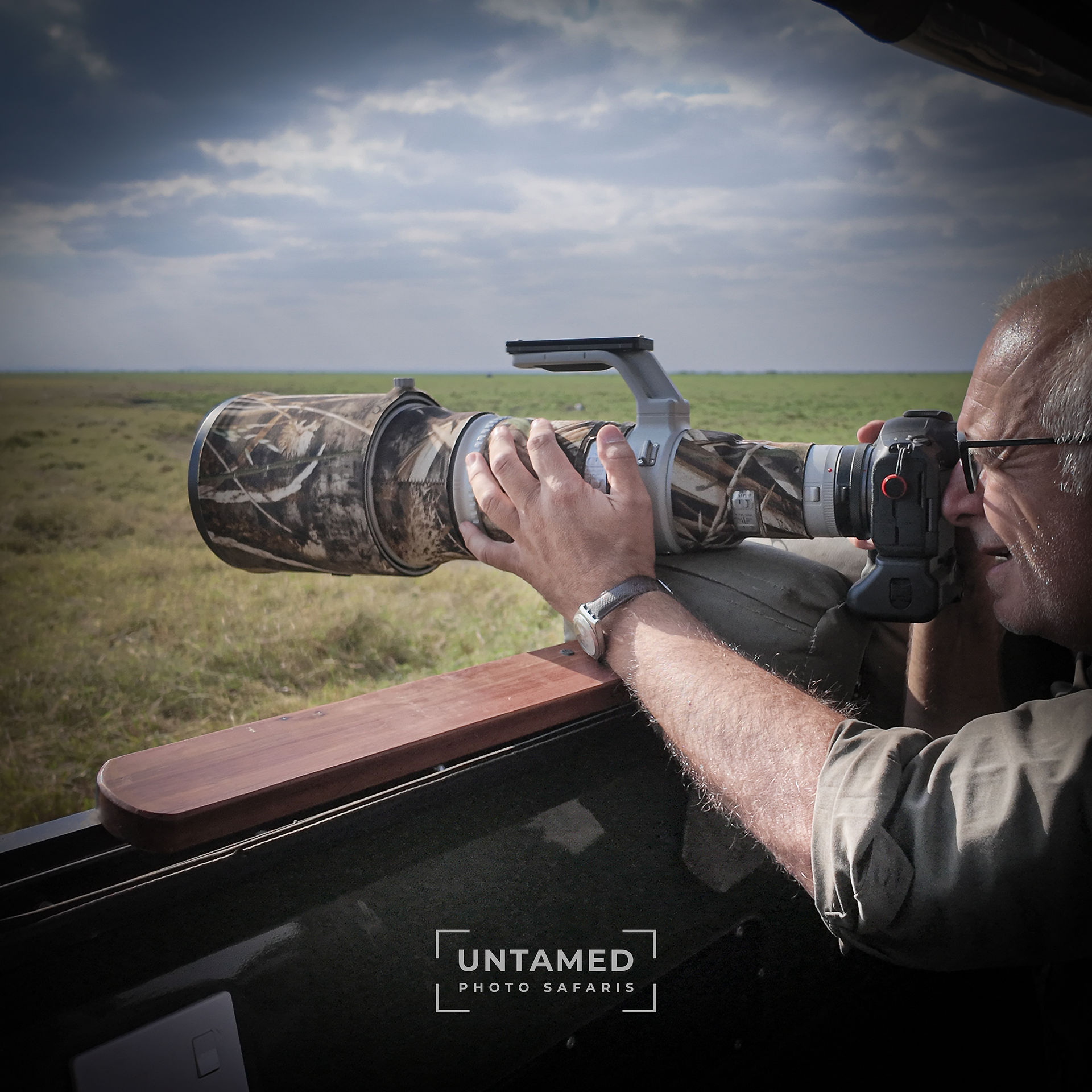
Photo Safaris Masai Mara 
Photo Safaris Masai Mara 
Photo Safaris Masai Mara
Photo Tips and the Best Lenses
The best lens for the Masai Mara depends on the type of images you want to create, but a flexible setup is highly recommended. The Mara offers everything from distant predators to close elephant encounters, wide landscapes, birds, action, portraits, and migration scenes. This means photographers should prepare for a range of focal lengths.
A long telephoto lens is one of the most important pieces of equipment for the Mara. A 500mm or 600mm prime is excellent for tight portraits, birds, distant subjects, and isolating animals against soft backgrounds. These lenses are particularly useful for cheetahs, leopards, smaller mammals, and birds. They also help when you need to keep distance from sensitive sightings while still creating strong images.
However, because a fixed 500mm or 600mm lens does not allow you to zoom in or out, it also forces you to become more creative with your composition. If the safari vehicle cannot move, you have to work with the frame you are given rather than simply reframing with the lens. This can push you to focus on details, negative space, textures, eye contact, behaviour, and more intentional framing. In many ways, the limitation of a prime lens can make you a stronger photographer, because it encourages you to think more carefully about how to build an image. A fixed lens however will give you the best quality when it comes down to detail in the image.

A telephoto zoom, such as a 100-500mm, 200-600mm, or similar lens, is extremely useful because the Mara can change quickly. A lion may begin far away and then walk toward the vehicle. A cheetah may move from resting to hunting. Elephants may approach more closely than expected. A zoom gives you flexibility without needing to change lenses in dusty conditions.


A 70-200mm lens is one of the most valuable lenses for the Masai Mara. Many photographers underestimate how often this range becomes useful. It is excellent for larger animals, environmental portraits, action at medium distance, and scenes where the landscape is part of the story. Lions, elephants, giraffes, wildebeest, zebras, and migration groups can all work beautifully at 70-200mm.

A wider lens, such as a 24-70mm or 24-105mm, is also worth carrying. This is especially useful for dramatic skies, vehicle-based wide-angle moments, landscapes, camp scenes, elephants at close range, and environmental storytelling. In the Mara, some of the strongest images are not the tightest ones. A wide frame that includes sky, grassland, and subject can often say more about the place than a close portrait. This lens however is not needed if your packing light.


For camera bodies, two bodies are ideal. One can carry a long lens, while the other carries a mid-range or wide zoom. This avoids lens changes in dusty environments and allows faster reactions when a scene changes. Wildlife photography is often about being ready. If the correct lens is buried in a bag, the moment may be gone before you can use it.
A beanbag is essential for vehicle-based photography. It provides stability, especially with long lenses, and allows smoother shooting from low or side positions. A monopod or tripod is usually less practical in a safari vehicle, although this depends on the vehicle setup. Extra batteries, memory cards, external hard drives, a dust blower, and lens cloths are also important. The Mara can be dusty, and equipment care should be part of your daily routine.
In terms of technique, photographers should keep shutter speed in mind at all times. Wildlife moves quickly, and even resting animals can turn their heads suddenly. For general wildlife, a shutter speed of 1/1000 second or faster is often useful. For action, birds, running cheetahs, or moving wildebeest, 1/2000 second or higher may be needed. For still subjects in low light, you can go slower, but only if your technique and support are solid.
Depth of field also matters. Wide apertures such as f/2.8 or f/4 can create beautiful subject separation, but they require accurate focus. For groups of animals, larger subjects, or scenes where you want more detail, f/5.6 or f/8 may be better. The goal is not to use one setting for everything, but to understand what the image needs.

Working With Light
Light is one of the most important elements of wildlife photography, and the Masai Mara offers some of the most beautiful light in East Africa. The same subject can look completely different depending on the time of day, direction of light, and surrounding atmosphere. Understanding how to work with different lighting conditions is essential.
Morning Light
Morning is often the most productive time for photography in the Mara. The light is soft, low, and directional, giving shape to the landscape and warmth to the subject. Wildlife is often more active during the cooler hours, which increases the chance of behaviour, movement, and hunting activity.
In the morning, side light can be especially effective. It reveals texture in fur, grass, dust, and muscle, while also creating depth. A lion walking through side light or a cheetah sitting with the sun just off to one side can produce a much stronger image than a flatly lit subject.
Backlight can also be beautiful in the morning, particularly when there is dust, mist, or long grass. Backlit animals can glow around the edges, creating a rim of light that separates them from the background. This works well with lions, cheetahs, giraffes, elephants, and wildebeest. Exposure needs to be handled carefully, because strong backlight can fool the camera meter. It is often better to protect the highlights and allow some shadow depth rather than over-brightening the entire scene.
Morning is also a good time for wide environmental images. The Mara’s open plains, soft skies, and low light allow photographers to create images that show the animal within the landscape. This is where a 70-200mm or 24-105mm lens can be especially useful.
Evening Light
Evening light in the Mara can be spectacular. As the sun drops, the plains take on a warm glow and the landscape becomes more atmospheric. Animals often become more active again, and the final hour of light can produce some of the strongest images of the day.
Evening is an ideal time for backlight, silhouettes, and dust. If a herd moves through dry grass or a predator walks through a dusty track, the low sun can turn the scene into something dramatic. This is where patience matters. Rather than rushing from one sighting to another, it is often better to stay with a promising subject and wait for the light to improve.
Silhouettes can work beautifully in the Mara because the landscape is open and the animal shapes are often recognisable. Giraffes, elephants, lions, cheetahs, and wildebeest can all make strong silhouettes if positioned against a clean sky. The key is to expose for the bright background and keep the subject shape clear.
Evening is also a time to think about emotion and atmosphere. The best images are not always the most action-filled. A lioness watching the horizon, elephants moving into the last light, or wildebeest gathering beneath a dramatic sky can all become powerful photographs when composed carefully.
Resting Animals (Morning/Evening)
Shutter speed: 1/500 sec to 1/1000 sec
Aperture: f/4 to f/5.6
ISO: Auto ISO, often between ISO 800 and 3200 depending on the morning light
Focus mode: Continuous autofocus or single-shot autofocus if the subject is completely still
Drive mode: Low-speed continuous or single shooting
Metering: Evaluative or centre-weighted metering
Stabilisation: On, especially when using a long telephoto lens from a vehicle or beanbag
Animals in Action (Morning/Evening)
Shutter speed: 1/2000 sec to 1/3200 sec
Aperture: f/4 to f/5.6
ISO: Auto ISO, often between ISO 1600 and 6400 in early morning light
Focus mode: Continuous autofocus with animal tracking if available
Drive mode: High-speed continuous shooting
Metering: Evaluative metering, with exposure compensation if needed
Stabilisation: On, especially when shooting from a vehicle or beanbag
Birds in Flight (Morning/Evening)
Shutter speed: 1/3200 sec to 1/5000 sec
Aperture: f/4 to f/6.3
ISO: Auto ISO, often between ISO 1600 and 6400 in early morning light
Focus mode: Continuous autofocus with bird tracking if available
Drive mode: High-speed continuous shooting
Metering: Evaluative metering, especially when birds are moving against the sky
Stabilisation: On, especially when panning with the subject
Harsh Daylight
Harsh daylight is more challenging, but it does not mean photography has to stop. The middle of the day often brings strong contrast, bright highlights, and less flattering light. However, experienced photographers can still make good images by changing their approach.
During harsh light, it is often better to look for behaviour, shape, graphic compositions, or subjects in shade. Leopards resting in trees, lions under bushes, elephants at water, birds in flight, or animals against clean backgrounds can still work well. Black and white photography can also be effective in harsh conditions because it allows you to focus on form, texture, contrast, and mood.
Exposure control is important in harsh light. Bright grass, pale dust, white birds, and reflective highlights can easily become overexposed. Checking your histogram and using exposure compensation can help protect detail. It is usually better to slightly underexpose bright scenes than to lose highlight detail completely.
This is also a good time to focus on smaller details and storytelling images. Tracks in the dust, vultures gathering, animals resting in shade, or the heat shimmer across the plains can all help tell the story of the Mara. Not every image has to be a perfect golden-light portrait.
The Great Migration
The Great Migration is one of the most famous wildlife events on earth, and the Masai Mara is one of the best places to photograph it. Each year, vast numbers of wildebeest, along with zebras and other grazers, move through the greater Serengeti-Mara ecosystem in search of fresh grass and water. When the migration reaches the Mara, the landscape changes. Herds spread across the plains, predator activity increases, and river crossings can create some of the most dramatic wildlife photography opportunities in Africa.
For photographers, the Great Migration is both exciting and challenging. The scale of the event can be overwhelming, and the most dramatic moments can happen quickly. Strong migration photography requires preparation, patience, and the ability to tell a story beyond the obvious action.
River crossings are the most famous migration scenes, but they are also some of the most difficult to photograph well. A crossing may take hours to begin, or it may not happen at all. Wildebeest often gather near the river, hesitate, move away, return, and repeat the process many times. Photographers need patience and should avoid chasing every movement. The best approach is to choose a good position, understand the likely crossing point, and wait without adding pressure to the animals.

When photographing crossings, shutter speed is important. Wildebeest move quickly, water splashes, and action can be chaotic. A fast shutter speed such as 1/2000 second or higher is often useful for freezing movement. If the light is lower, you may need to increase ISO to maintain speed. Continuous autofocus and high-speed burst mode can help, but timing and composition still matter more than simply holding down the shutter.
A 100-500mm, 200-600mm, or 500mm lens can be excellent for river crossings, especially when you need reach. However, wider lenses can also be powerful when the scene involves large numbers of animals, dramatic dust, or a broad view of the river. It is useful to have two bodies ready, one with a long lens and one with a wider zoom, because crossings can change very quickly.
The best migration images are not always the most dramatic. Photographers should also look for quieter scenes: wildebeest moving across golden plains, zebra patterns in morning light, calves staying close to adults, predators watching the herds, or vultures gathering after a hunt. These images help tell the full story of the migration, rather than focusing only on river crossings.
Ethics are especially important during the Great Migration. The pressure around crossings can be intense, and poor vehicle behaviour can disrupt the animals. Photographers should work with guides and hosts who understand responsible positioning and who prioritise the welfare of wildlife. The best photographs should never come at the expense of the animals’ natural behaviour.

Getting to the Masai Mara
The Masai Mara can be reached by both road and air, depending on the style of safari and the overall itinerary. For photographers, the choice of transport can make a significant difference to comfort, time in the field, and how much energy you have when you arrive.
Flying is often the most efficient way to reach the Mara, especially for guests on a high-end photographic safari or those linking multiple destinations within Kenya. Light aircraft flights connect the Mara with Nairobi and other safari regions, reducing travel time and allowing more time for game drives. This can be especially valuable when travelling with limited days and a strong photographic focus.
Driving to the Mara is also possible and can be more economical, but it is a longer journey. For some travellers, the road transfer provides a sense of moving through Kenya’s landscapes, but for photographers carrying heavy equipment, flying is often more comfortable and efficient. The best option depends on the itinerary, budget, luggage requirements, and the specific routing.
When planning a photography safari, baggage allowance should be considered carefully. Camera gear can be heavy, particularly for photographers carrying long lenses, two camera bodies, laptops, hard drives, and accessories. At Untamed Photo Safaris, we understand the needs of photographers and build logistics around realistic equipment requirements wherever possible.
The Mara also works extremely well as part of a multi-location Kenya itinerary. It can be combined with Amboseli for elephant photography, Lumo Conservancy for the Tsavo ecosystem and hide photography, or other specialist areas depending on the season and photographic goals. A well-designed route should give each destination enough time to deliver, rather than rushing through too many places.

Why Go With a Wildlife Photographer?
A safari with a wildlife photographer is very different from a general wildlife safari. Most safari guides are excellent at finding animals and explaining behaviour, but photography requires an additional layer of decision-making. The best photographic opportunities depend not only on the sighting, but on how the sighting is approached.
A wildlife photographer thinks about light direction, background, distance, angle, lens choice, shutter speed, behaviour, and the likely next movement of the subject. These decisions happen constantly in the field. Should the vehicle move forward or wait? Is the background clean? Is the light improving or getting worse? Is the animal likely to move into a better position? Should you use a wide lens or a long lens? Is this a moment to shoot, or a moment to wait?
Having a photographer as a host means guests receive practical, real-time guidance. This can include camera settings, exposure decisions, autofocus modes, composition, lens choice, and how to prepare for action before it happens. It also means having someone who understands the frustrations of wildlife photography: missed focus, difficult light, cluttered backgrounds, fast movement, and the challenge of making something different from a familiar subject.
A photographic host also helps with creative development. Many photographers arrive wanting sharper images, but leave understanding that strong wildlife photography is about much more than sharpness. It is about light, behaviour, mood, timing, perspective, and storytelling. A good host helps guests see those opportunities more clearly.
On an Untamed Photo Safaris trip, the goal is not simply to place guests in front of wildlife. The goal is to help them make better images. That means patient positioning, thoughtful fieldcraft, ethical wildlife behaviour, and guidance from people who understand what photographers need.

Mark Fernley 
Jaren Fernley
Our Photo Safari Trucks
Vehicle setup has a huge impact on the quality of a photographic safari. In many standard safari vehicles, guests may be crowded, equipment space may be limited, and photographers may struggle to move, change lenses, or work from the best angle. For serious wildlife photography, this can be frustrating and limiting.
At Untamed Photo Safaris, we limit our vehicles to only three photographers per truck. This is one of the most important parts of our safari experience. It means each guest has proper space for themselves and their equipment, with room to move and work comfortably. Instead of competing for a view or trying to shoot over other guests, photographers have the freedom to respond quickly and compose properly.
Having only three photographers per vehicle also allows for better positioning. When a subject moves, the guide and photographic host can think about the needs of the whole vehicle without trying to satisfy too many people at once. This makes a major difference when working with light, low angles, and clean backgrounds.
Our photo safari trucks are designed around photographers. Space, comfort, access, and shooting angles all matter. The goal is to make the vehicle a proper photographic platform, not just transport between sightings. For wildlife photographers, this is essential. A great sighting can easily be wasted if the vehicle setup does not allow you to shoot properly.
The three-seat one side setup also supports a calmer safari experience. There is less noise, less movement, and less pressure inside the vehicle. This helps guests focus, think creatively, and enjoy the process of photography. Wildlife photography often requires patience, and a well-designed vehicle environment makes that patience much easier.

Our Photo Safaris
Untamed Photo Safaris creates photographic safaris for guests who want more than a standard wildlife tour. Our trips are built around photographers, with careful attention to locations, timing, vehicle setup, guiding, and photographic tuition in the field. We focus on creating opportunities for strong images while maintaining a respectful, ethical approach to wildlife.
The Masai Mara plays an important role in several of our Kenya itineraries because it offers such exceptional photographic variety. It is one of the best places in Africa for big cats, open savannah scenes, migration photography, and classic East African wildlife images. Whether guests are photographing lions in golden light, cheetahs on the move, elephants in wide landscapes, or wildebeest during the Great Migration, the Mara gives photographers an extraordinary range of opportunities.
Our approach is professional, practical, and field-focused. We help guests make decisions in real time, from camera settings and lens choice to positioning and composition. We also understand that different photographers have different goals. Some may want to improve their technical skills, while others may be building a portfolio, working on creative storytelling, or hoping to capture a specific behaviour or species.
A Masai Mara photo safari with Untamed Photo Safaris is about time in the field, space to work, and guidance from experienced wildlife photographers. We do not rush from sighting to sighting simply to tick off species. We work with the light, read the behaviour, and give our guests the best possible chance to create images with impact.
For photographers looking to experience the Masai Mara properly, travelling with a specialist photographic safari company can make all the difference. The Mara is already one of the greatest wildlife destinations in the world. With the right planning, vehicles, guiding, and photographic support, it becomes one of the most rewarding places on earth to grow as a wildlife photographer and build a portfolio of unforgettable African images.
We hope you have enjoyed this Masai Mara Wildlife Photographer’s Guide and that it has given you a better understanding of what makes the Mara such a special place for wildlife photography.
At Untamed Photo Safaris, we are passionate about helping photographers experience this incredible ecosystem in the right way, with time, patience, expert guidance, and respect for the wildlife at the heart of every safari.


